Here’s an Unpopular opinion that you aren’t ready for:
AI overviews and GEO are now a bigger game-changer for traffic generation than SEO. Ask why?
Generative Engine Optimisation, or GEO, updates digital content so it’s readable by large language models (LLMs) like Gemini or ChatGPT.
This content is then summarised and presented as Answer snippets or an AI overview that you see at the beginning of your Google search. Here, the AI model will cite your brand in generated answers.
Consider this blog a step-by-step guide on how GEO can help your business.
What Are Google AI Overviews (SGE), and Why Should B2B Care in 2026?
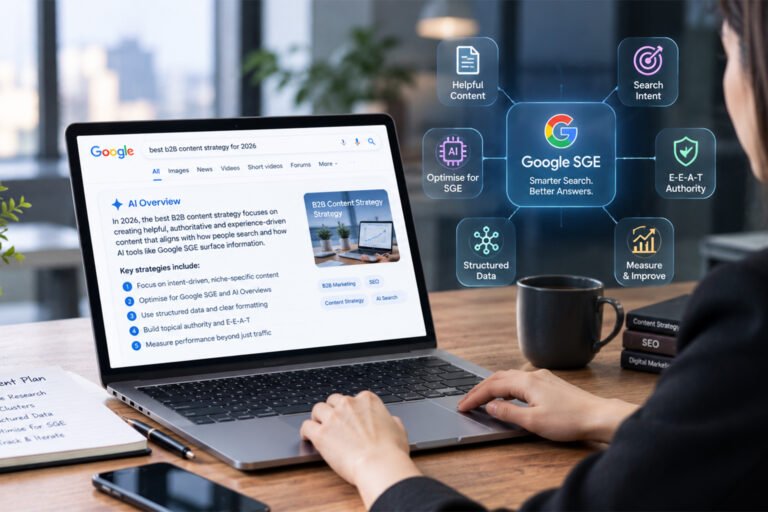
AI overview is simply Gemini that comes as a summary of the answer for a Google search at the top of the results page.
When Gemini provides the summary, it is typically taken from multiple websites, which they usually cite after every line it has used.
Now, the direct result of this feature is that most people do not enter any websites at all
This reality of optimisation is called the “Zero Click” dynamic, where most of the searches don’t have any clicks on website links.
Sounds Problematic?
Well, not really.
Ranking in searches is still important; you need to learn how to use this new feature to your advantage.
How???
The GEO Framework for B2B Content
This is the answer to your how.
- Mapping buyer prompts to citable Pages in the Stakeholder matrix
What’s that?
Let me dumb it down for you.
Here, instead of sending the URL to your target audience, you let AI do it for you.
Or, more like, not giving your eggs in different places but putting them in one basket. That basket will be your Stakeholder matrix.
In this basket, you keep one egg, which will be your buyer prompts or, more likely, the questions your audience searches on Google.
The other eggs are the citable links from which you extract the answers.
- Write Citation‑Ready Answer Blocks and structure your Content for Machine Learning
When you are providing content on your website, make sure it is not selling but actually focused on solving a problem.
Place a 40–60 word direct answer under each H2 that mirrors the query. This helps Google take the answer directly from your page.
This way, your website becomes more visible to AI.
- Strengthen Entity Signals: Authors, Profiles, and Canonical Entity
AI doesn’t just read your words; it checks who is saying them. If your content has no clear author, no real bio, and no linked profiles, why should Gemini trust you enough to cite you?
Start publishing under real people. Add headshots, short bios, and links to LinkedIn or industry profiles. Keep your company name, address, and branding consistent everywhere—your site, directories, social profiles.
If you’re serious, claim or contribute to Wikidata or Wikipedia entries so Google sees your brand as one clear, canonical entity.
Still treating AI Overviews like a “nice to have”? That’s how you become invisible in 2026.
If you want your brand cited—not buried—start with a real GEO audit.
At ARKCA Digital Solutions, we’ve put together a simple checklist that shows exactly which pages to fix, what answers to add, and how to structure them so AI actually picks you up.
Drop a comment or DM us “GEO” and we’ll send it over. No fluff, just the stuff that moves the needle.